HS Code vs HTS Code: What Importers Need to Know
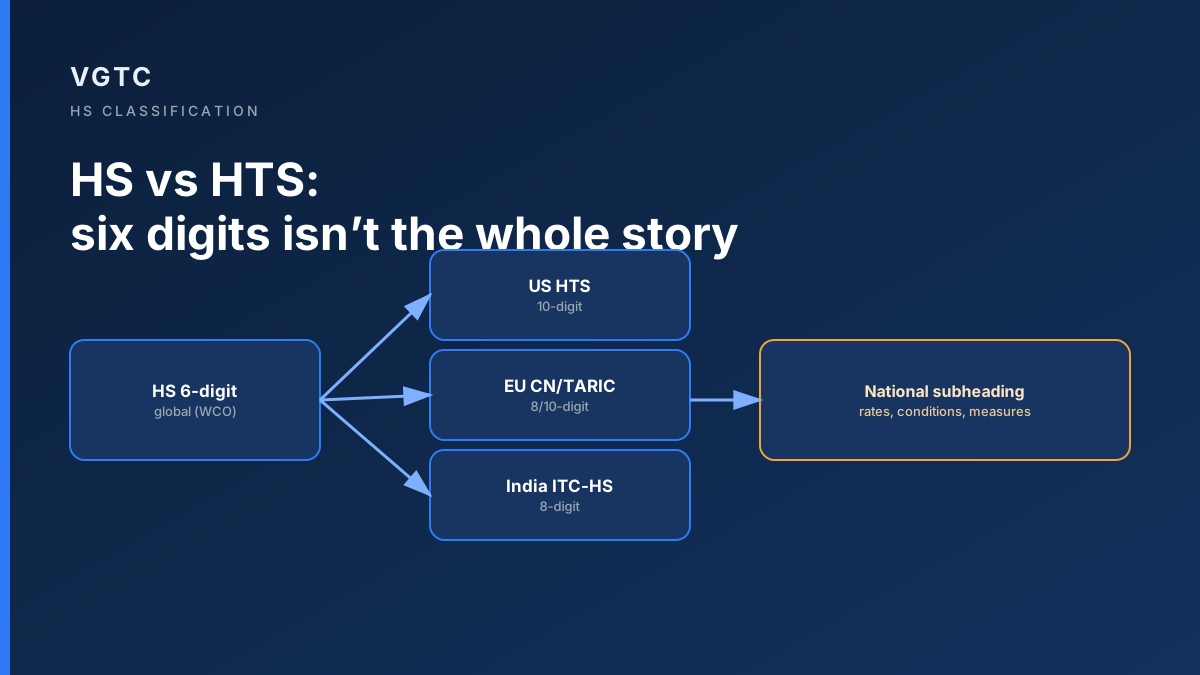
The 6-digit HS code is international; the HTS is the United States' national extension of it — and the digits beyond six are where duty rates and legal obligations actually live. How the systems fit together across major markets.
"We already have an HS code from our supplier — why is your tool asking for an HTS code?" Because they are not interchangeable, and treating them as such is a classic source of entry errors.
The HS: the shared foundation
The Harmonized System is a multipurpose nomenclature maintained by the World Customs Organization and used as the basis for customs tariffs by well over 200 economies. Countries commit to the first six digits: a product classified under heading 8471 (automatic data processing machines) carries those same six digits whether it lands in Rotterdam, Houston or Ho Chi Minh City. The WCO periodically updates the nomenclature to keep pace with technology; the current edition took effect in 2022, so edition dates matter when reading older documents. A revised HS edition takes effect on 1 January 2027 — check the WCO website or your national authority for the latest schedule and any heading changes affecting your products.
What happens after six digits
Below the shared six digits, every trading bloc runs its own extensions — and this is where rates, preferences and restrictions are defined:
| Jurisdiction | National schedule | Typical depth | Set by |
|---|---|---|---|
| United States | HTS (HTSUS) | 8-digit legal + 10-digit statistical suffixes | USITC / ITC |
| European Union | Combined Nomenclature + TARIC | CN 8-digit; TARIC codes add further subdivisions (up to 14 digits where measures require) | European Commission |
| United Kingdom | UK Global Tariff / UK Trade Tariff | 8-digit commodity codes with further subdivisions | HMRC |
| India | ITC(HS) | 8-digit tariff and policy lines with policy conditions | DGFT / CBIC |
| Vietnam | AHTN-based national tariff | 8-digit | Ministry of Finance decrees |
The practical consequence: two exporters can quote 'the same HS code' and still declare completely different national codes at import. Duty rates attach to the national digits, not to the six-digit prefix.
How classification decisions actually cascade
- Determine the 6-digit code using the HS General Rules of Interpretation plus section and chapter notes — these notes are part of the law, not optional commentary.
- Apply the destination country's national subheadings, reading its own explanatory notes.
- Check for statistical suffixes or TARIC subdivisions that trigger reporting or measure obligations.
- Only then look up duty — against the full national code, on the official schedule, for the current period.
Where people go wrong
- Using an EU CN code on a US entry (or vice versa) because 'they start the same'.
- Stopping at eight digits in markets that require ten, producing invalid declarations.
- Assuming identical descriptions across countries imply identical codes — national legal notes diverge below six digits.
- Citing an outdated nomenclature edition after an HS update reorganized relevant headings.
VGTC's tariff converter exists precisely for this seam: it extends HS codes toward national schedules with a curated lookup of representative US HTS, EU CN and Vietnam AHTN lines. It is a starting point for research, not a comprehensive cross-schedule translator — coverage is deliberately limited to codes we have verified. As always with our tools, the output is decision support — the declarant of record confirms the final code against the official schedule.
Primary sources
- Harmonized System (HS) Nomenclature overview — World Customs Organization, accessed 2026-08-25
- Harmonized Tariff Schedule of the United States (HTS) — US International Trade Commission, accessed 2026-08-25
- TARIC — EU integrated tariff (CN and TARIC codes) — European Commission, DG TAXUD, accessed 2026-08-25
- ITC(HS) import/export policy schedule — Directorate General of Foreign Trade, Government of India, accessed 2026-08-25
Editorial review team. Verified against the primary sources cited in-text. Educational content, not an official classification or customs determination.
Regulatory requirements change. Verify current rules with the relevant authority before relying on this material for a shipment. VGTC is decision-support software; nothing here is an official customs determination.
Apply this in VGTC
Tariff Converter
Extend a 6-digit HS code toward national schedules from our curated verified lookup.
Related articles
Stay ahead of trade compliance changes
Get practical regulatory updates and VGTC product guidance. No spam — unsubscribe anytime.
Periodic practical updates on customs, HS classification, sanctions, CBAM and Vietnam trade. See our Privacy Policy. Unsubscribe anytime via the link in every issue.