EVFTA Rules of Origin for Vietnam–EU Trade: What Actually Qualifies a Shipment
The EU–Vietnam FTA cuts duties to zero for most goods — if the product qualifies as originating and you can prove it. Product-specific rules, tolerance, cumulation, direct transport and proof of origin, with primary sources.
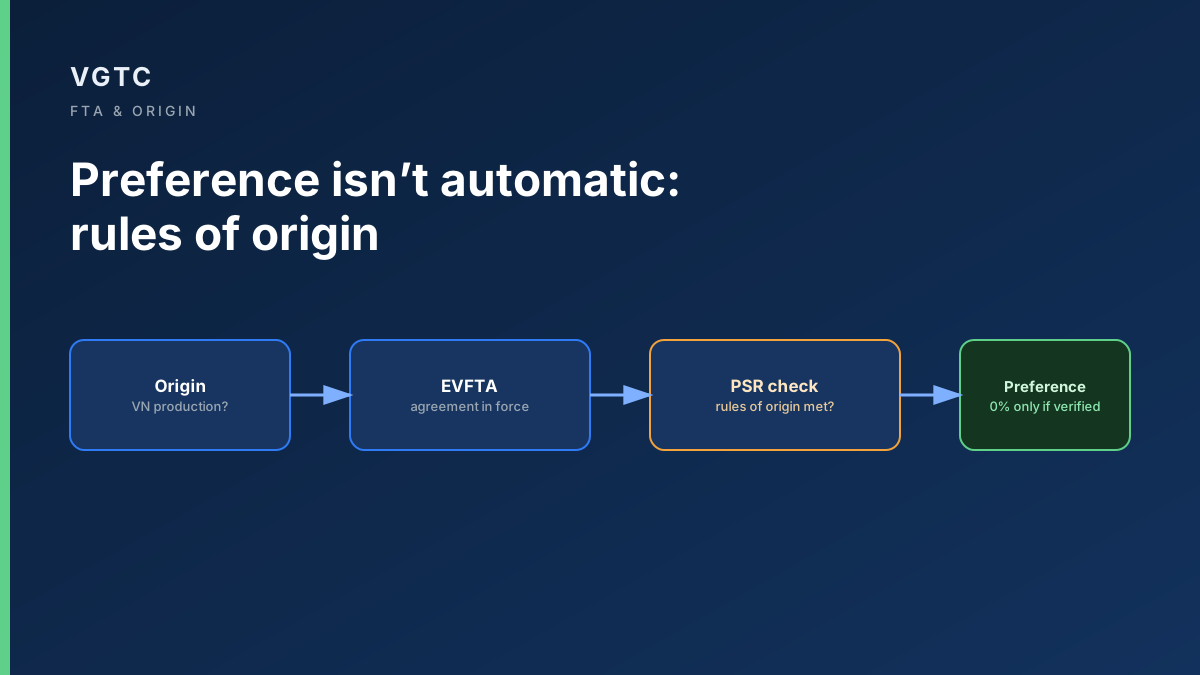
The EVFTA entered into force on 1 August 2020 and phases out tariffs on the large majority of goods traded between Vietnam and the EU. But the preferential rate is never automatic. Two questions decide whether your shipment pays the EVFTA rate or the MFN rate: is the product originating, and can you prove it?
1. Is your product 'originating'?
Wholly obtained products (grown, harvested, extracted in Vietnam) are straightforward. The hard cases are manufactured goods using non-Vietnamese inputs. For those, Protocol 1 of the agreement sets product-specific rules per heading: change-of-tariff-classification requirements (e.g., CTH — change of tariff heading), or value-based tests such as maximum non-originating material content or minimum regional value content, sometimes with alternative routes ('or' rules). Read the rule for YOUR exact HS code — generalizing from another product's rule is how shipments lose preference at import.
2. Tolerance and cumulation — know when they save you
- Tolerance: Protocol 1 allows limited use of non-originating materials above the normal threshold for defined products, subject to caps expressed in the protocol's notes and chapter-specific conditions. Treat it as a fallback that must be checked, not assumed.
- Cumulation: materials originating in the EU generally count as originating in Vietnam (bilateral cumulation), and the protocol provides further cumulation possibilities under defined conditions. Because the scope has evolved since entry into force, verify the current provisions in Protocol 1 rather than relying on older summaries.
3. Direct transport / non-alteration
Preferential treatment requires consignment criteria too: goods must move from Vietnam to the EU without being altered outside the parties' territories. Splitting shipments or processing through a third country can be workable under the agreement's conditions (e.g., non-transformation activities, documented storage), but the burden of demonstrating compliance sits with the importer/exporter — plan documentation accordingly.
4. Proof of origin: self-certification
Unlike systems built on government-issued certificates, the EVFTA uses self-certification: an exporter declares the originating status on documents accompanying the shipment (an 'origin declaration'). Registered exporters can self-certify regardless of value; exporters without registration may issue declarations only for consignments up to the low-value threshold set in Protocol 1 — confirm the current figure in the protocol text before relying on it. REX-style registration used elsewhere in EU FTAs is not the Vietnamese mechanism; do not mix procedures across agreements.
- Confirm the product-specific rule for your exact code (ROSA + Protocol 1).
- Collect supplier declarations/BOM evidence supporting every input claim.
- Run any tolerance/cumulation calculations and archive the worksheet.
- Issue the origin declaration with required data elements, signed by an authorized person.
- Retain origin records for the period specified in the protocol — audits ask for history, not intentions.
- Verify the preferential measure actually exists for your TARIC line at import time (TARIC shows preferences by origin).
On the Vietnamese side, preferential import schedules implementing the FTA are promulgated through government decrees that get reissued as phase-down years advance. If your workflow cites decree numbers, re-verify them periodically — VGTC encodes these schedules with explicit version notes precisely because they move.
Primary sources
- EU–Vietnam Free Trade Agreement (text incl. Protocol 1 — rules of origin) — European Union (EUR-Lex), accessed 2026-08-25
- Rules of Origin Self-Assessment tool (ROSA) — EVFTA covered — European Commission, DG TRADE, accessed 2026-08-25
- Access2Markets — quick guide to working with rules of origin — European Commission, accessed 2026-08-25
- TARIC consultation (verify current preferential measures per code) — European Commission, DG TAXUD, accessed 2026-08-25
Editorial review team. Verified against the agreement text and official Commission guidance cited below. Educational content; origin determinations for a specific shipment should be confirmed with your customs broker or the issuing authority.
Regulatory requirements change. Verify current rules with the relevant authority before relying on this material for a shipment. VGTC is decision-support software; nothing here is an official customs determination.
Apply this in VGTC
VNACCS Validator
Check a Vietnam declaration for common pre-filing errors — tax ID, HS, regime, Incoterms.
Related articles
Stay ahead of trade compliance changes
Get practical regulatory updates and VGTC product guidance. No spam — unsubscribe anytime.
Periodic practical updates on customs, HS classification, sanctions, CBAM and Vietnam trade. See our Privacy Policy. Unsubscribe anytime via the link in every issue.